
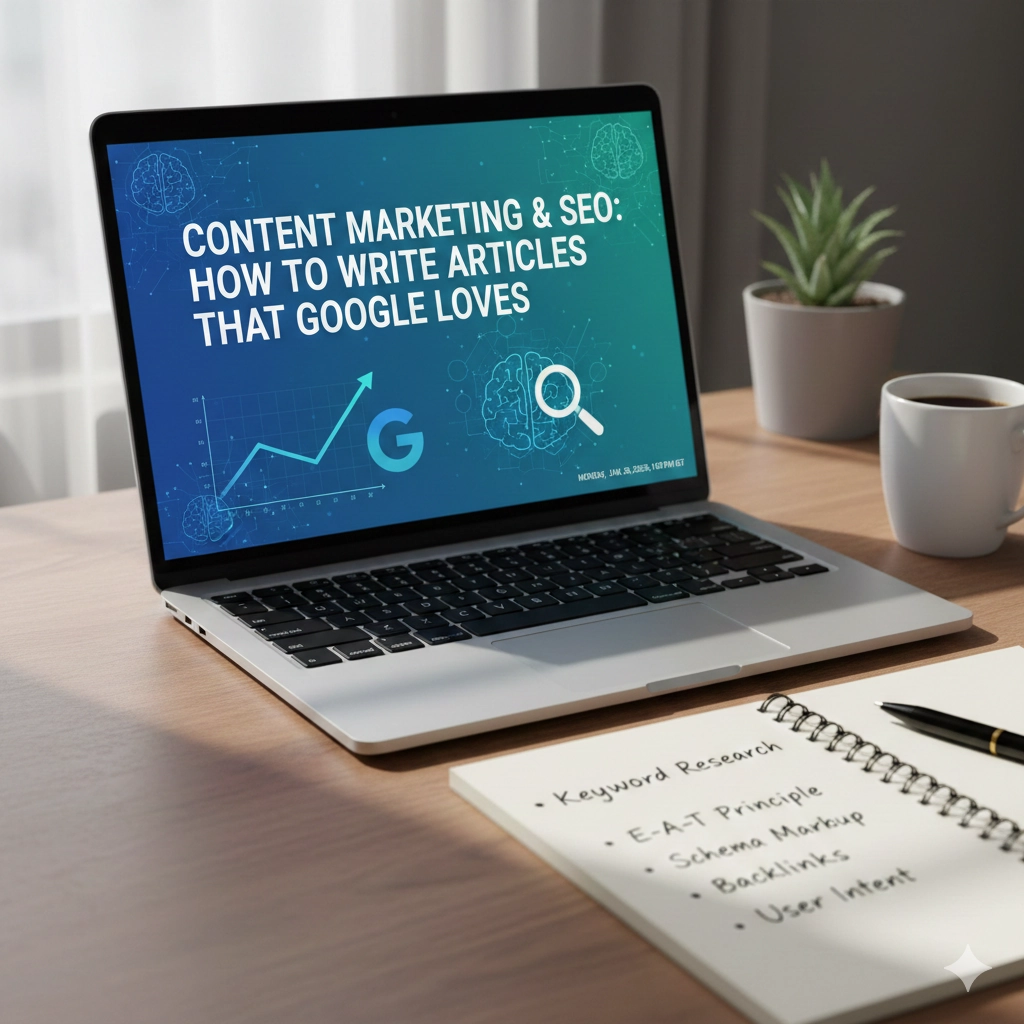
Content Marketing & SEO: How to Write Articles That Google Loves in 2026
The era of writing for algorithms is officially over. In 2026, Google’s systems are powered by advanced Generative AI and the Search Generative Experience (SGE). These systems have become experts at identifying content that genuinely helps humans.
If you want your articles to rank today, you need to balance technical precision with authentic and high-value storytelling. Here is how to write content that both Google and your readers will love.
1. Master the Search Intent Deep Dive
Keywords still matter, but intent is the new king. Before you write a single word, analyze what the user actually wants when they type a query.
Informational: They want a quick answer or a deep guide.
Transactional: They are ready to buy or sign up.
Commercial: They are comparing options, such as “Top 10 tools.”
Navigational: They are looking for a specific brand or page.
The 2026 Strategy: Do not just target “SEO tips.” If the top results are all videos, your 2,000-word blog post might struggle. Align your format, whether it is a listicle, guide, or case study, with what Google is already rewarding for that specific intent.
2. Double Down on E-E-A-T
Google’s Search Quality Rater Guidelines emphasize Experience, Expertise, Authoritativeness, and Trustworthiness. In a world full of AI-generated noise, “Experience” is your greatest competitive advantage.
Show, Do Not Just Tell: Include personal anecdotes, original photos, or unique data from your own experiments.
Author Bios: Ensure every article has a clear author box detailing their credentials and social links.
Cite Sources: Link to high-authority domains and include a “Fact Checked By” note if applicable.
3. Structure for Scanability and AI Summaries
With the rise of AI Overviews (SGE), Google often summarizes your article at the very top of the results page. To be the source of that summary, you must be organized.
The Answer First Method: Answer the primary question of your article in the first 50 to 60 words.8 This makes it easy for AI to clip your answer.
Logical Heading Hierarchy: Use one $H1$ for the title, $H2$s for main sections, and $H3$s for sub-points.
Bullet Points & Tables: Google loves structured data.9 If you are comparing products or listing steps, use a table or a numbered list.
4. Optimize for the Multi-Modal Searcher
In 2026, people do not just search with text. They use Voice Search and Visual Search via Google Lens.
5. Prioritize Page Experience (Core Web Vitals)
You can write the best article in the world, but if the page takes 5 seconds to load on a mobile device, Google will penalize you.
Mobile-First Design: Ensure buttons are tap-friendly and text is readable without zooming.
Fast Loading: Compress your images and minimize heavy scripts.
Engagement Signals: Google tracks how long people stay on your page. Interactive elements like calculators, quizzes, or jump-link menus keep users engaged longer.
6. Use Keywords Naturally — Not Excessively
Keywords still matter in SEO, but in 2026, stuffing your article with the same keyword repeatedly is one of the fastest ways to make your content feel outdated and unnatural.
- Place Your Main Keyword Smartly: Include it in your title, introduction, at least one heading, and conclusion.
- Use Semantic Variations: Add related terms like “SEO blog writing,” “Google-friendly content,” and “content optimization tips.”
- Avoid Keyword Stuffing: Repeating the same phrase too often can reduce readability and weaken trust.
- Write Around the Topic: Cover subtopics and related questions that support your main keyword.
- Focus on Context: Google cares more about whether your article truly answers the topic than how many times you repeat the keyword.
7. Create In-Depth, Helpful Content
Google now rewards content depth much more than surface-level writing. A short article can work for simple questions, but for competitive topics like SEO and content marketing, detailed and genuinely useful content usually performs better.
- Answer the Full Topic: Don’t just explain what something is — explain how it works, why it matters, and how to use it.
- Include Real Examples: Practical examples make your content easier to understand and more trustworthy.
- Solve Related Questions: Think beyond the main keyword and answer follow-up questions readers may have.
- Use Actionable Advice: Give readers tips they can actually apply immediately.
- Avoid Fluff: More words do not always mean better content. Every section should add value.
8. Add Real Examples and Practical Insights
One of the easiest ways to make your blog more powerful is to include real examples, mini case studies, and practical writing guidance.
- Show Before-and-After Examples: Demonstrate how a weak heading or paragraph can be improved.
- Use Mini Case Studies: Share small examples from campaigns, content tests, or SEO improvements.
- Add Tool Mentions: Mention useful tools where relevant, such as keyword research tools or content optimization tools.
- Include Common Mistakes: Tell readers what to avoid, not just what to do.
- Give Templates or Frameworks: Readers love structures they can reuse for their own content.
9. Optimize for Featured Snippets and AI Overviews
Google increasingly shows quick answers, AI summaries, and featured snippets at the top of search results. If your article is structured clearly, you increase your chances of being selected for those high-visibility placements.
- Answer Questions Directly: Give a clear answer immediately after the heading.
- Use Short Definition Paragraphs: Keep important answers simple and concise.
- Add Numbered Steps: Step-by-step content is easier for Google to extract and display.
- Use Bullet Points: Lists are highly scannable and snippet-friendly.
- Include FAQ Sections: Frequently asked questions help capture more search variations.
10. Strengthen Internal Linking
Internal links help both Google and readers understand how your website content is connected. It is one of the simplest but most effective SEO practices, especially for blogs.
- Link Related Articles: Connect this article to your other blogs on SEO, content marketing, social media, or digital strategy.
- Use Keyword-Rich Anchor Text: Instead of saying “click here,” use phrases like “SEO content writing tips” or “digital marketing strategy.”
- Guide the Reader Naturally: Internal links should feel helpful, not forced.
- Support Important Pages: Link to your service pages, portfolio, or contact page where relevant.
- Improve Crawlability: Internal links help Google discover and understand more of your website.